



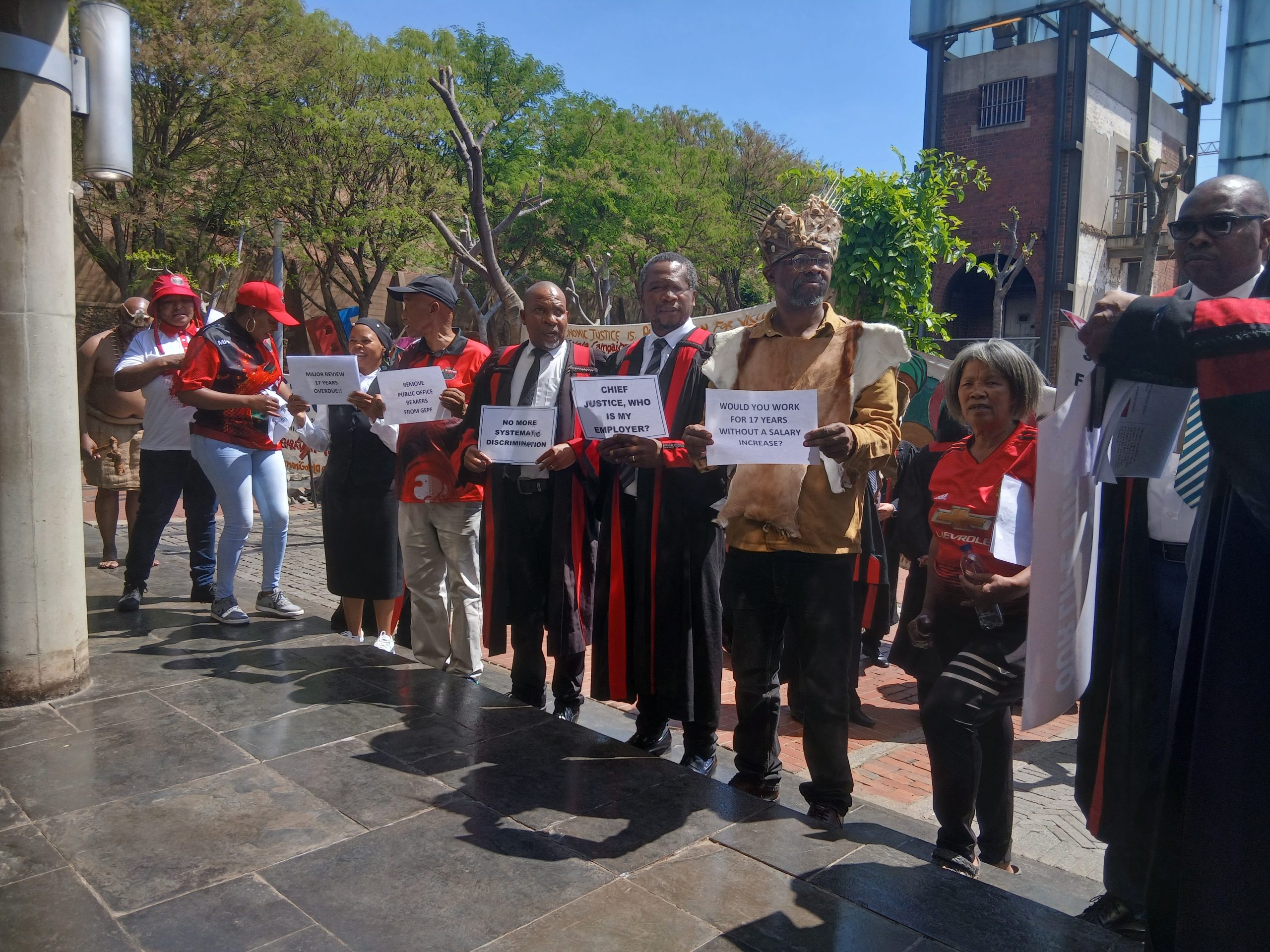
Magistrates marched to the Constitutional Court in Johannesburg on Friday, demanding better working conditions and an end to what they call “financial abuse” and lack of recognition within South Africa’s judicial system.
The group, representing the Judicial Officers Association of South Africa (JOASA), handed over a memorandum outlining their grievances. They say they are excluded from key employment benefits such as medical aid and housing subsidies, and lack adequate tools of trade to perform their duties effectively.
Magistrates also complained that prosecutors earn more than them, despite magistrates carrying greater judicial responsibility. Many travelled from KwaZulu-Natal and various parts of Gauteng to join the march, wearing their black and red judicial robes and holding placards in the blazing Friday afternoon heat. Even tourists passing by stopped to show support.
JOASA President Neely Karikan said magistrates have long been treated unfairly within the judiciary.
“There is systematic economic abuse against us. High Court judges get the benefits they are entitled to, but when it comes to magistrates, we are totally neglected we are like the stepchild of the judiciary,” Karikan said.
He warned that continued neglect could lead to a crisis in the justice system.“We are in a constitutional crisis. On paper, we claim to have an independent judiciary, but in reality, that independence does not extend to all judicial officers.”
Karikan criticised President Cyril Ramaphosa for delaying the signing of a long-awaited Major Review Report on magistrates’ remuneration and benefits a process that has reportedly been pending for 17 years.
“The President referred the Major Review Report back to the remuneration committee for reconsideration, and we are still waiting for him to sign it off,” he said.
He added that magistrates handle the majority of cases in South Africa’s courts, yet remain undervalued.“The judiciary is not just the High Court. Ninety-five percent of the work is done in the Magistrates’ Courts so why are we being ignored?” he asked.
The march also drew solidarity from other groups, including Nehawu and representatives of the Khoi and San traditional leadership, who said their struggles for recognition mirror those of the magistrates.
“We support them because they are also human beings like all of us,” said Geremy Sapier from the Khoi and San traditional leadership. “We’ve been struggling for over 20 years to get recognition from the government.”
Organisers claimed that many magistrates who wanted to participate were intimidated or threatened and therefore stayed away.
Business Day reported that in an affidavit filed in the Gauteng High Court in August, President Cyril Ramaphosa acknowledged the concerns raised by magistrates but argued that the implementation of the Major Review Report is a complex process involving several stakeholders, including the National Treasury.
Ramaphosa said the review’s recommendations have “wide-ranging fiscal implications” and cannot be adopted piecemeal. He explained that the report covers multiple categories of public office bearers — not only magistrates — and therefore requires a coordinated decision.
“It is quite impossible to deal with the recommendations in isolation,” Ramaphosa said in his affidavit. “Even if there were no concerns affecting magistrates — and there are — I could not make a recommendation for them to the exclusion of all other public office bearers.”
He said he has referred the report back to the Independent Commission for the Remuneration of Public Office Bearers for reconsideration, and that there is no legally binding timeframe compelling him to act before receiving the commission’s updated advice.


