



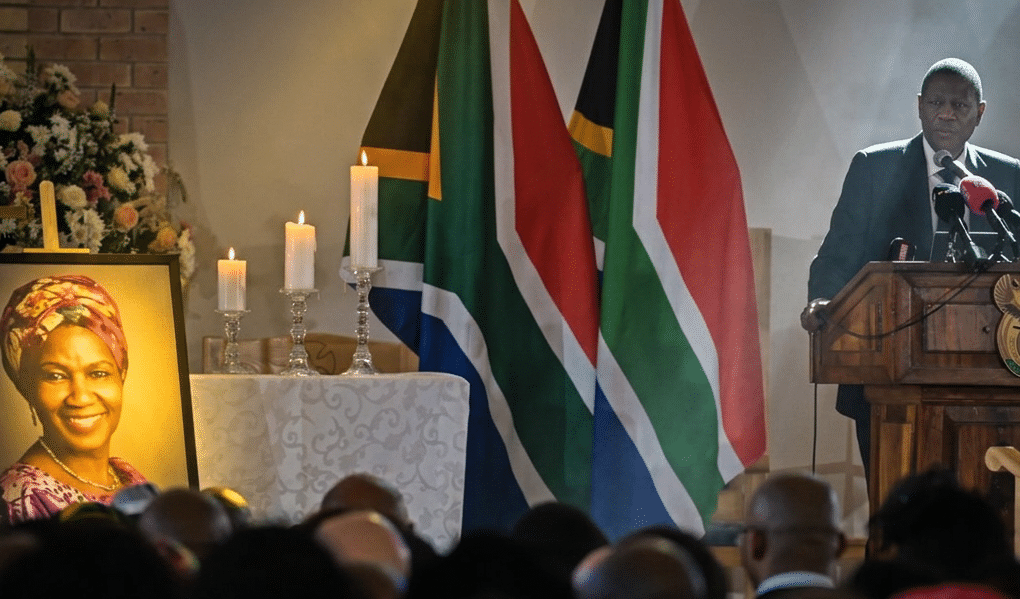
Deputy President Paul Mashatile has paid tribute to the late former Deputy President Dr Phumzile Mlambo-Ngcuka, describing her as an African trailblazer and global champion of gender equality whose legacy continues to inspire the fight for women’s empowerment, education and social justice.
Mashatile was speaking at Mlambo-Ngcuka’s memorial service at Our Lady of Lourdes Catholic Church in Rivonia, Johannesburg, on Monday. Political leaders, family members, friends and dignitaries gathered to celebrate her life and reflect on her contribution to South Africa and the international community.
He said her legacy should not be measured solely by the positions she held, but by the lives she transformed, the barriers she broke and the causes she championed.
“Today, we gather in mourning, but also in reflection. A life such as hers cannot be measured only by the years she lived or the offices she held. It must be measured by the lives she touched, the barriers she broke, the causes she advanced and the legacy she leaves behind,” Mashatile said.
He described Mlambo-Ngcuka as a freedom fighter, activist, nation-builder and tireless advocate for women’s emancipation and social justice.
According to Mashatile, she believed that freedom extended beyond political rights and required creating meaningful opportunities for women, young people and historically disadvantaged communities to improve their lives.
He said she understood that women’s empowerment was fundamental to economic development, equality and national prosperity.
“Indeed, her life affirmed a simple but powerful truth that, when women rise, families thrive; when families thrive, communities prosper; and when communities prosper, nations flourish,” he said.
A pioneering journey in South African politics
Mashatile reflected on Mlambo-Ngcuka’s contribution to South Africa’s democratic transition, particularly her involvement in the country’s first democratic Parliament and the Constituent Assembly, which paved the way for the adoption of the Constitution in 1996.
She subsequently served as Deputy Minister of Trade and Industry and Minister of Minerals and Energy, where she championed economic transformation and broader participation in key sectors of the economy.
Her contribution to the mining industry included supporting reforms designed to address historical inequalities and expand opportunities for previously disadvantaged South Africans. These efforts contributed to the development of the Mining Charter.
In 2005, Mlambo-Ngcuka made history when she became South Africa’s first woman Deputy President under former President Thabo Mbeki.
During her tenure, she played a role in initiatives such as the Accelerated and Shared Growth Initiative for South Africa (ASGISA) and the Joint Initiative on Priority Skills Acquisition (JIPSA), which focused on economic growth, skills development and poverty reduction.
A global voice for women’s rights and gender equality
Mlambo-Ngcuka’s influence extended well beyond South Africa’s borders when she was appointed United Nations Under-Secretary-General and Executive Director of UN Women.
In this role, she became a prominent international advocate for gender equality, mobilising governments, businesses, universities and civil society organisations through initiatives such as the HeForShe campaign.
Mashatile recalled her determination to see women represented in leadership positions across all sectors of society, including the highest offices in government.
He said her message was not simply about encouraging women to pursue leadership, but also about challenging institutions and societies to dismantle the structural barriers that prevented women from advancing.
He added that she recognised that the problem was not a shortage of capable women, but systems, attitudes and inequalities that denied them equal opportunities.
Education, peace-building and African development
Mashatile also highlighted Mlambo-Ngcuka’s commitment to education, which she regarded as a powerful instrument for individual advancement, social transformation and national development.
She served as Chancellor of the University of Johannesburg while continuing her own academic journey through doctoral studies.
He further recalled a recent meeting with her to discuss potential contributions to peace-building initiatives in South Sudan, where he serves as a special envoy.
According to Mashatile, she immediately expressed her willingness to assist, demonstrating her continued commitment to peace and stability across the African continent.
He also acknowledged her involvement in the 2022 mediation efforts between the Ethiopian government and the Tigray People’s Liberation Front, highlighting her belief in dialogue, diplomacy and African-led solutions to conflict.
‘Her mission lives on’
Mashatile called on South Africans to honour Mlambo-Ngcuka’s memory by continuing the work to which she dedicated her life, particularly the advancement of women and girls.
He said the country must strive to build a society in which every child has access to opportunities, regardless of their circumstances, and every individual can fulfil their potential.
He also emphasised the importance of ensuring that women have access to leadership and decision-making positions throughout society, including the highest office in the country.
Mashatile said her legacy would endure through women who step forward to lead, young people who pursue education and communities that continue to champion equality, justice and human dignity.
“Her earthly journey has come to an end, but her mission lives on. It lives on in every woman who steps forward to lead,” he said.
On behalf of President Cyril Ramaphosa, the government and the people of South Africa, Mashatile extended condolences to her husband, Bulelani Ngcuka, her children, family members, friends and political comrades.
He concluded his tribute with a heartfelt farewell:
“Farewell, Dr Phumzile Mlambo-Ngcuka. Lala ngoxolo dadewethu. Robala ka khotso moetapele wa Rona.”
Mlambo-Ngcuka will be laid to rest at a Category 2 state funeral on Saturday in Middledrift, in the Eastern Cape.

