





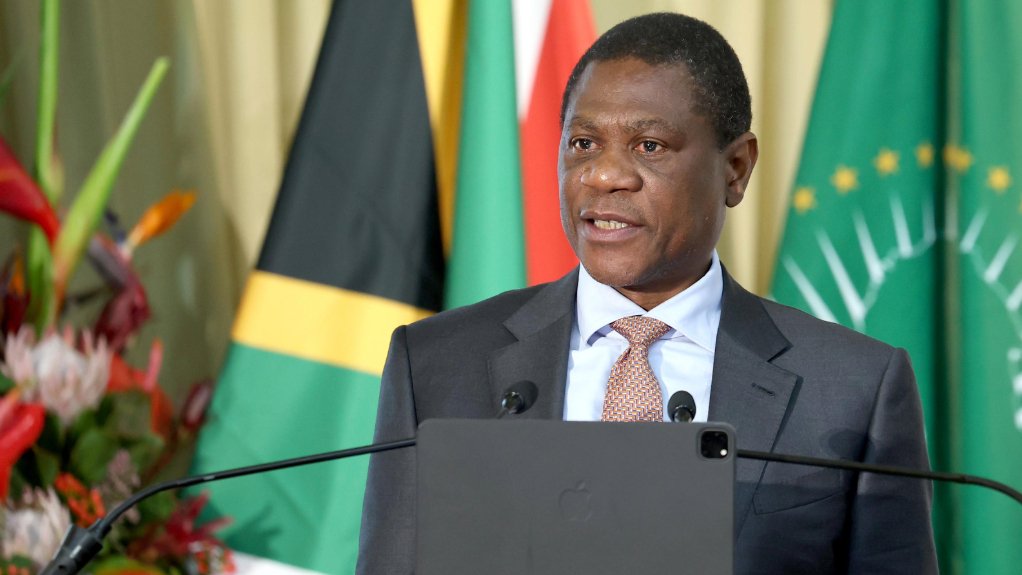
Deputy president Paul Mashatile has warned that political interference in the running of government departments and State Owned Entities makes it impossible for the state function optimally. Mashatile held a round table panel discussion in Pretoria where he cautioned against the removal of key officials by politicians without sound reason. He said interference has resulted in high turnover in state institutions which in turn leads to inconsistency in policy implementation among others.
“The evaluation findings show that when the interface is unstable, plans remain unfunded, policies are inconsistently applied, and citizens lose trust in the state. When Directors-General are routinely removed or undermined, when procurement processes are politicised, or when coordination efforts fail due to poor design and mistrust — it is not just departments that suffer; it is the South African people,” said the Deputy President.
Mashatile said to achieve the desired professionalisation of the civil services would require urgent reform aimed at among others creating an environment for better relations between directors general as well as heads of departments and political principals.
“This calls, amongst others that we re-visit our institutional design to respond to governance deficits that in certain instances manifest themselves through acts of corruption and malfeasance. The recently launched white paper on local government , which seeks to review the 1998 version, is one among the many interventions being undertaken by this administration,” said Mashatile.
It has become a norm in South Africa for directors general and senior managers to be moved around whenever there is a political transition and Mashatile said there must be a review to minimise the negative effects of this.
The Deputy President said his observations were based on an evaluation conducted by the Human Sciences Research Council under the stewardship of the presidency’s policy and research unit. He said the report was a wake-up call to the state and a product of deep self reflection.
“It serves as a sobering mirror held up to the state, revealing systemic vulnerabilities, institutional dysfunction, and a lack of protection for those entrusted to lead departments and drive delivery,” said Mashatile.
He said among others the following should be done urgently to position South Africa as a “capable developmental and ethical state”:
“If we are to make significant strides in the implementation of our development goals, we must work towards the de-politicisation of the public service through the recommended policy and legal reforms.
The depoliticisation Accounting Officers and Executive Authorities relationship is a matter of urgency.
It is important to stress that de-politicisation is not about diminishing the importance of political leadership, but rather about role clarification, appropriate devolution of power and clarifying the lines of accountability to enable optimal functioning of both the executive and administrative leadership.
“This means that the public service needs to be immersed in the development agenda but insulated from undue political interference. We need to institutionalise administrative duties and the ability to carry out government programmes regardless of political leadership transitions. Transitioning to a capable developmental state necessitates a series of bold actions that place the state at the centre of the transformational process, most notably with respect to leadership,” said Mashatile on necessary reforms.


