


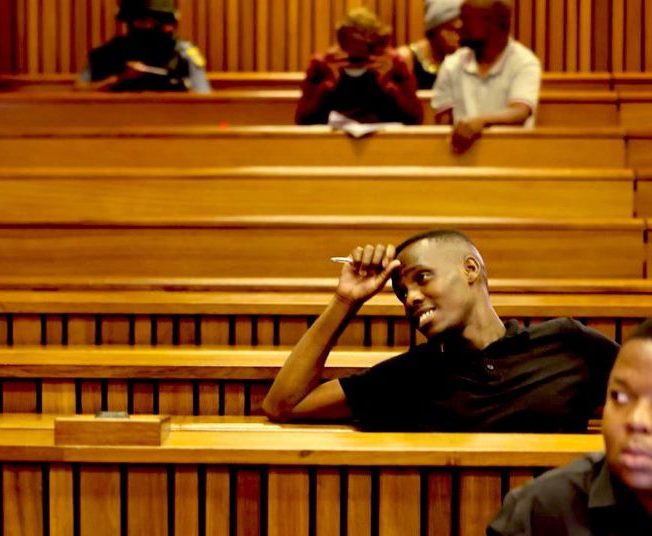
More than a decade after the fatal shooting of former Bafana Bafana captain Senzo Meyiwa, the murder trial continues to expose deep questions about police procedure, evidence handling and the integrity of the investigation itself. Fresh testimony in the Pretoria High Court this week shifted attention to how crucial evidence linked to one of the accused was allegedly handled while in custody, as the defence intensified efforts to challenge the credibility of the State’s case.
Colonel Silas Thoka, station commander at Villieria Police Station, testified on Tuesday that he had no official knowledge of accused Bongani Ntanzi allegedly possessing a cellphone in his prison cell — an issue that has become central to the defence’s argument about procedural irregularities and possible mishandling of evidence.
Thoka appeared as the third witness called by Ntanzi’s defence team. His testimony focused largely on police records, occurrence books and SAPS procedures relating to confiscated items. According to the State, Ntanzi was found with a cellphone while in custody, and the contents of the device later became part of the broader investigation. However, under questioning from defence advocate Sipho Ramosepele, Thoka repeatedly maintained that no official complaint or proper documentation regarding the cellphone had been brought to his attention.
The trial proceedings were briefly delayed after Ramosepele informed the court that only two of the three requested occurrence books had been provided to the defence. Despite objections over the missing records, proceedings eventually continued, with the defence using the available documentation to probe gaps in police procedure.
Ramosepele argued that the circumstances surrounding the cellphone’s seizure appeared irregular from the outset. He told the court that Ntanzi was allegedly approached casually by police officials and asked to hand over the device. According to the defence’s version, Ntanzi voluntarily retrieved the cellphone and surrendered it before it was packaged at Villieria Police Station in his presence. The phone was then reportedly transported the following day, 8 February 2021, to the Tactical Support Unit in Mpumalanga for data extraction and forensic downloading.
Throughout the cross-examination, Thoka insisted he had no personal knowledge of the incident or the handling of the device. He further testified that standard SAPS procedures require any item found in a prison cell to be officially registered and properly returned or processed through formal channels. When asked whether the occurrence book reflected any formal charge against Ntanzi on 26 October 2020 — the date he was allegedly booked into the Villieria holding cells — Thoka confirmed there was no such entry.
The defence maintains that the absence of proper documentation casts serious doubt over the chain of custody surrounding the cellphone evidence. Ramosepele argued that critical steps, including the seizure, registration, packaging and forensic processing of the device, do not appear to comply with established SAPS protocol. The issue forms part of a broader defence strategy aimed at questioning the admissibility and reliability of evidence presented by the State.
Ntanzi is standing trial alongside co-accused Muzikawukhulelwa Sibiya, Mthobisi Mncube, Mthokoziseni Maphisa and Fisokuhle Ntuli for the 2014 murder of Senzo Meyiwa. The celebrated Orlando Pirates and national team goalkeeper was shot dead on 26 October 2014 at the Vosloorus home of singer Kelly Khumalo’s mother during what was initially described as a house robbery. The killing shocked South Africa and remains one of the country’s most closely followed criminal cases.
Kelly Khumalo, who was present in the house on the night of the shooting, has not been charged in connection with Meyiwa’s murder. However, her name continues to surface throughout public debate surrounding the case. Various witnesses over the years have referenced tensions, conflicting statements and unanswered questions involving people who were inside the house when Meyiwa was killed. Despite intense public scrutiny and speculation, prosecutors have consistently maintained that the five accused men were responsible for the murder and related offences.
The case has also drawn attention to the role of the Independent Police Investigative Directorate (IPID), which previously became involved amid allegations of misconduct, torture and procedural violations linked to the investigation. Some of the accused claimed they were assaulted, threatened and coerced into making confessions after their arrests in 2020. These allegations prompted scrutiny of certain police officers and investigative methods used during the case. IPID’s involvement added another layer of controversy to an already highly sensitive trial, particularly as defence lawyers continue to argue that parts of the State’s evidence may have been improperly obtained.
Over the years, the Senzo Meyiwa investigation has been marred by claims of lost evidence, inconsistencies in witness statements, changing investigative teams and accusations of political interference. The prolonged delays and procedural disputes have fuelled widespread public frustration and intensified calls for accountability from both law enforcement authorities and prosecutors.
Legal counsel Zithulele Ncumalo, representing accused Mthokoziseni Maphisa, is expected to continue cross-examining Colonel Thoka when proceedings resume. The defence is anticipated to further probe the handling of evidence and the reliability of official police records as the trial enters another critical phase.
Judge Tshifiwa Ratha Mokgoatlheng continues to preside over the high-profile proceedings, which remain under intense national scrutiny as South Africans await long-delayed answers in the murder of one of the country’s most beloved football figures.