




President Cyril Ramaphosa has welcomed a new €11.5 billion (about R230 billion) investment package from the European Union (EU), describing it as a major step toward building South Africa’s “economy of the future” while strengthening long-standing trade and diplomatic ties with Europe.
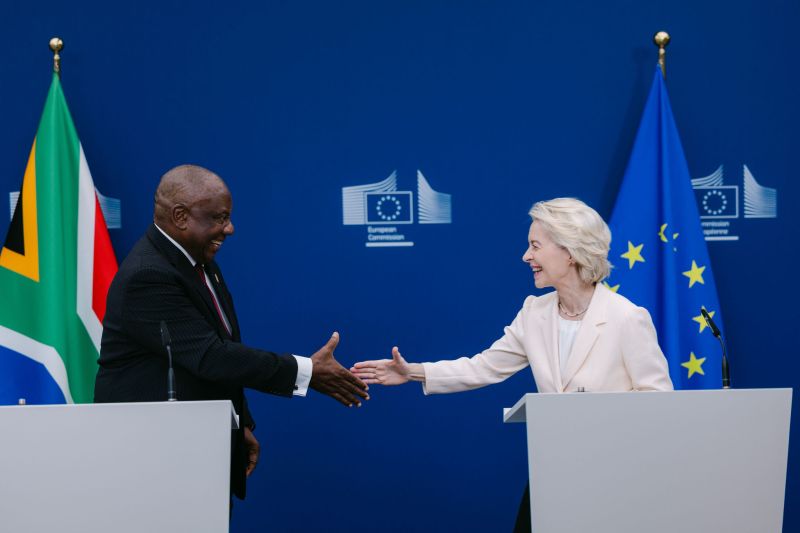
Ramaphosa stated that the package “opens new possibilities for trade and investment” and marks the start of “a new era of partnership and cooperation” between South Africa and the EU. This significant announcement was made jointly by Ramaphosa and European Commission President Ursula von der Leyen on the sidelines of the Global Gateway Forum held at the EU’s headquarters last week.
The investment package is set to support growth across various priority sectors, including green hydrogen, renewable energy, critical minerals, electric battery manufacturing, and vaccine production. Additionally, it will facilitate infrastructure development across essential areas such as rail, roads, ports, logistics, and digital connectivity.
Specifically, approximately R173 billion is earmarked for the Just Energy Transition, R24 billion for the Just Component, R20 billion in infrastructure and connectivity, and R6 billion to build the pharmaceutical value chain. “These investments will help to build the economy of the future in the South Africa of the present. We welcome the special focus on skills, small business development, and research and development. This is vital for the development of our people, our most valuable resource,” Ramaphosa said.
The EU remains South Africa’s largest trading partner and one of its most important sources of foreign direct investment (FDI), accounting for 41% of total FDI into the country. Over 2,000 EU companies operate within South Africa, supporting more than 500,000 direct and indirect jobs.
Ramaphosa further expressed that this new investment package advances the goals of the Clean Trade and Investment Partnership, agreed upon during the South Africa–EU Summit in Cape Town in March 2024. This initiative aims to promote clean energy transition, technology transfer, skills development, and strategic industrial growth across African value chains.
Ramaphosa expressed confidence that the partnership would accelerate South Africa’s transition to a low-carbon economy while positioning Africa as “the next frontier of clean global production.”
In a related development, the EU had announced a €4.7 billion Global Gateway package with South Africa in March, primarily aimed at boosting connectivity, with strong emphasis on enhancing local vaccine production and biomanufacturing capabilities.
During her meeting with Ramaphosa last week, von der Leyen announced that EU Member States would contribute nearly €12 billion to support the ambitions of the EU-South Africa Just Energy Transition Partnership, aiming to establish both parties as global leaders in clean energy.
“There are already so many inspiring projects on the ground. South Africa is not only transforming itself; it is becoming a clean energy pioneer for the entire continent. Global Citizen has initiated a campaign to scale up renewables in Africa where 600 million people still lack access to electricity,” she highlighted.
“This campaign is set to continue for a year, culminating in Johannesburg at the G20. We are collaborating closely to mobilise investments under our ‘Scaling Up Renewables in Africa’ campaign, alongside Global Citizen. Today, I am delighted to announce a new package of €618 million from Team Europe as a pledge to this campaign, which will support projects focused on electrification, modernising power grids, and expanding access to renewable energy,” von der Leyen added.
The Congress of South African Trade Unions (Cosatu) welcomed the EU’s investment package, calling it a significant boost to the economy, job creation, and local businesses, particularly within energy generation capacity. Matthew Parks, Cosatu’s parliamentary co-ordinator, referred to the investment as crucial in enhancing energy generation capacity, reducing carbon emissions, and expanding vital economic infrastructure.
“While we welcome this progressive announcement by the European Commission and South African government, it is imperative that these financial commitments manifest as investments and grants, rather than loans. South Africa must manage our debt trajectory meticulously and avert further indebtedness, especially foreign currency-denominated debt that could lead us into a perilous debt trap,” Parks cautioned.
“This investment package signifies a positive vote of confidence in South Africa as the leading industrial economy on the African continent and a strategic partner for the European Union,” he concluded.


