


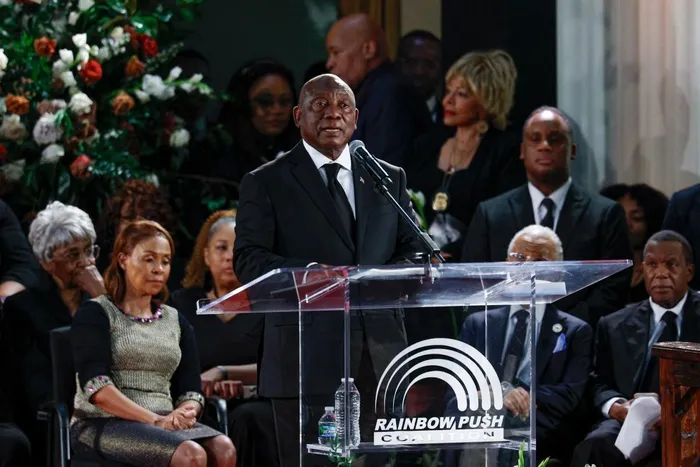
President Cyril Ramaphosa has described the late anti-apartheid activist, Reverend Jesse Jackson, as a beacon who carried the fight against apartheid across the world.
He was speaking during Jackson’s funeral service in Chicago in the United States. Jackson passed away last month at the age of 84 following a long illness.
Ramaphosa told mourners that South Africa also claims Jesse Jackson as one of its own, because he pledged his solidarity with the country’s struggle against apartheid.
“In the long and painful years of our struggle, when the voices of our people were often silenced, Jesse Jackson chose to belong to us by raising his voice against apartheid on our behalf.
When our cause was ignored and many would look away, he stood firm in solidarity with us.
He looked at people he had never met and said: their pain is my pain. Their chains are my chains. Their struggle for freedom is my struggle,” said Ramaphosa.
Ramaphosa said that during the dark and isolated years of apartheid, Jackson was one of the few global figures who stood firmly with oppressed South Africans.
In addition, the president highlighted that Jackson often drew comparisons between the African American struggle in the United States and the system of apartheid and injustice in South Africa.
He noted that former president Nelson Mandela and his comrades were also inspired by Jackson’s activism while they were serving life sentences on Robben Island.
“He was a voice that refused to be silenced when silence would have been easier. A voice that preached a message of hope from the streets of Chicago to the dusty streets of Soweto, that justice was not a privilege for the few, but a birthright for all.
His rallying call ‘Keep hope alive’ became a compass for our struggle and gave us hope for victory over the evil system of apartheid exclusion, division and oppression,” Ramaphosa remarked.
According to the president, Jackson’s bravery saw him visit apartheid South Africa in 1979 to pledge his allegiance to the anti-apartheid struggle, drawing large crowds at rallies in Soweto.
“When the Ronald Reagan administration chose what he described as ‘constructive engagement’ — diplomatic language for doing nothing — Jackson chose unconditional solidarity with the oppressed majority in South Africa.
He became the most visible American political figure advocating for comprehensive pressure and economic sanctions against South Africa,” Ramaphosa said.
Ramaphosa also revealed that Jackson and his two sons were arrested outside the South African embassy in the United States while protesting against the apartheid government.
In 1985, Jackson marched with then ANC president Oliver Tambo, Anti-Apartheid Movement president Trevor Huddleston, and more than 150,000 people in Britain to demand sanctions against South Africa and the release of Nelson Mandela.
“Not only did he march in the streets; he walked into the corridors of power.
He personally lobbied Pope John Paul II to visit South Africa and hasten change.
He pressed Mikhail Gorbachev to cut all Soviet diplomatic ties with Pretoria.
He challenged Margaret Thatcher to her face. She refused to budge, but he did not stop,” Ramaphosa highlighted.
The president added that when Nelson Mandela was released in 1990, Jackson was among those who welcomed him in Cape Town and was also present when Mandela was inaugurated as South Africa’s first democratically elected president in 1994.


