



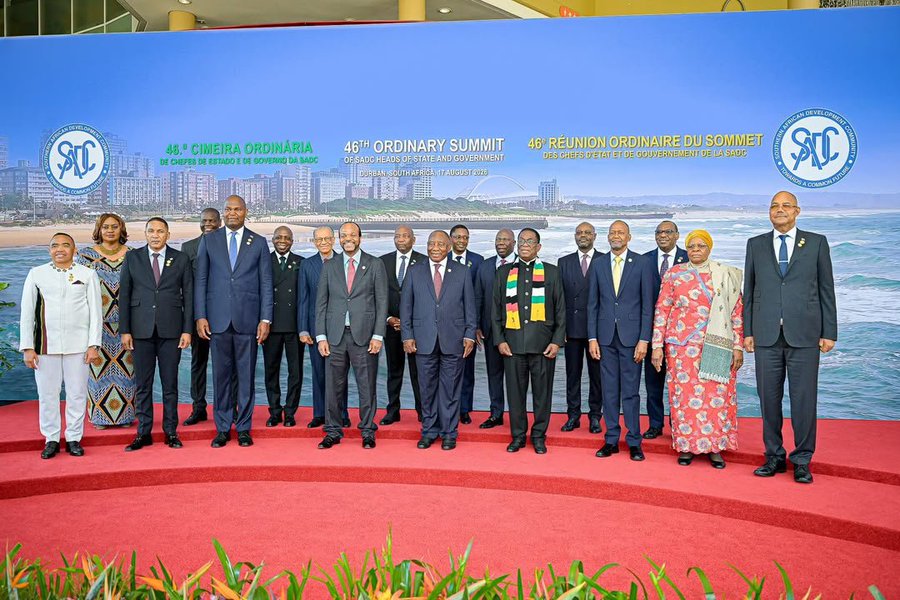
President Cyril Ramaphosa has used the Southern African Development Community (SADC) Summit in Durban to make a strong call for greater African economic independence, urging the continent to reclaim control of its natural resources and use them to finance its own development.
In a wide-ranging special lecture delivered at the summit, Ramaphosa argued that Africa must move beyond exporting raw materials and importing finished products if the continent is to achieve its long-term development ambitions.
He said colonialism had left behind economic and infrastructure systems designed primarily to extract Africa’s resources rather than promote trade and integration between African economies.
“Colonialism did not merely conquer our people and occupy our land. It deliberately fragmented our region. It divided communities, separated producers from markets and constructed transport systems designed to carry Africa’s raw materials to distant shores rather than to connect African economies to one another,” Ramaphosa said.
Africa’s minerals and the energy transition
Ramaphosa pointed to Africa’s critical mineral wealth as a major opportunity for economic transformation, particularly as countries around the world accelerate the transition towards cleaner energy.
He argued that African countries should demand greater value from their mineral resources by increasing local processing and manufacturing rather than continuing to export minerals in raw form.
“This region holds a substantial share of the world’s critical mineral resources. Many of the materials upon which the energy transition of the entire planet depends lie beneath our soil,” he said.
“But these minerals continue to cross our borders in raw form. We export the ore and we import the battery. We supply an industrial revolution taking place somewhere else and we then purchase its products at a price set by others.
“We need to use our own resources to drive our own industrial revolution.”
The comments add to a growing debate across Africa about resource sovereignty, local beneficiation and the continent’s position in global supply chains.
Several African governments have introduced policies aimed at encouraging domestic processing of minerals and reducing dependence on the export of unprocessed resources.
Push for a new economic relationship
Ramaphosa’s remarks form part of a broader continental conversation about economic sovereignty and what many African leaders describe as the need to move away from forms of economic dependence inherited from the colonial era.
South Africa is pursuing the objectives of both the SADC Vision 2050 and the African Union’s Agenda 2063, which seek to promote industrialisation, regional integration, infrastructure development and improved living standards.
The push for greater economic independence also coincides with a renewed campaign for reparations for slavery and colonialism.
Ghana has emerged as a leading voice in the African Union’s reparations campaign and hosted a summit on the issue in Accra in June.
South African officials have also backed calls for reparations.
Minister in the Presidency Khumbudzo Ntshavheni recently argued that Africans deserve compensation for the historical injustices associated with slavery and colonialism.
“The Jews were compensated for the Holocaust, but Africans were not compensated for the slave trade and the after-effects of colonialism,” Ntshavheni said.
“Africans deserve not only an acknowledgment of the wrongs that were visited on them, but Africans deserve to be compensated.”
Ghana and the reparations campaign
Ghana’s role in the reparations campaign carries particular historical significance because of its position in the transatlantic slave trade.
The country has been tasked by the African Union with championing the continental reparations agenda and has secured participation from dozens of countries, including states in the Caribbean.
Ghanaian Foreign Minister Samuel Okuzeto Ablakwa has described the country’s role as part of its long-standing Pan-African tradition.
“Ghana has always been a Pan-African leader. We’re the first country to attain independence in sub-Saharan Africa and to prove that it is possible to fight imperial might, and win,” he said, according to the BBC.
Ghana was also a major departure point in the transatlantic slave trade, with millions of Africans transported from the region to the Americas.
For advocates of reparations, this history has made Ghana a significant centre for the campaign to secure recognition and compensation for the lasting effects of slavery and colonialism.
A changing global economic landscape
The debate comes as African countries seek to strengthen their bargaining power in a global economy increasingly focused on critical minerals needed for batteries, renewable energy technologies and other advanced industries.
For SADC and the wider African continent, the challenge is to convert resource wealth into manufacturing capacity, jobs, infrastructure and sustainable economic growth.
Ramaphosa’s message at the Durban summit was therefore not simply about mineral exports. It was a call for African countries to strengthen regional markets, develop local industries and capture a greater share of the value generated from the continent’s natural resources.
The success of that strategy will depend on whether African countries can translate political commitments into coordinated industrial policies, investment and regional trade while building the infrastructure and skills needed to support higher-value production.