


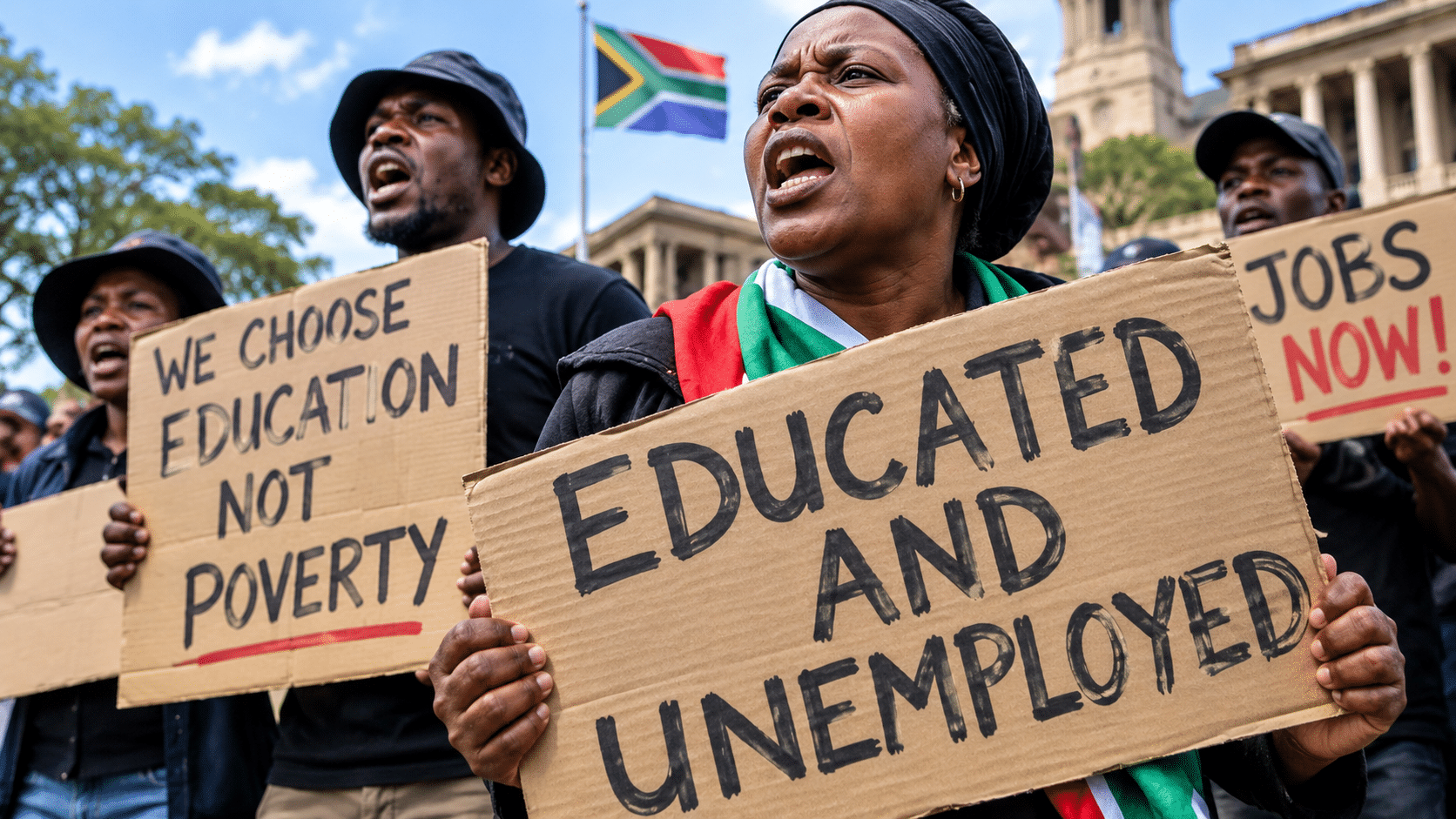
South Africa’s employment crisis continues to weigh heavily on households, with millions of people struggling to find work despite modest job gains in some sectors of the economy.
The latest Quarterly Labour Force Survey (QLFS) released by Statistics South Africa (Stats SA) shows that the official unemployment rate increased from 33.6% in the second quarter to 33.7% in the third quarter of 2026.
The number of unemployed people increased by 97 000 to 8.6 million, highlighting the difficulty of creating enough jobs to absorb the growing labour force.
Although the economy added 101 000 employed people, bringing total employment to 16.8 million, the increase was insufficient to prevent unemployment from rising.
The labour force expanded by 198 000, or 0.8%, during the same period.
Another worrying development was the increase in discouraged job-seekers. An additional 70 000 people stopped actively looking for employment, taking the total number of discouraged work-seekers to 3.7 million.
These are people who want to work but have stopped searching because they believe suitable opportunities are unavailable or that finding employment is unlikely.
Formal employment grows while other sectors lose jobs
The employment figures reveal significant differences in how industries performed during the third quarter.
Finance emerged as the biggest contributor to job creation, adding 111 000 positions. Manufacturing followed with 33 000 additional jobs, while mining contributed another 31 000.
However, employment losses in other sectors offset some of these gains.
Private households recorded a decline of 68 000 jobs, agriculture lost 34 000, and construction shed 8 000 positions.
The formal sector added 268 000 jobs, taking employment in the sector to 12.3 million.
In contrast, the informal sector lost 98 000 jobs, while private households recorded a further decline of 68 000.
The figures highlight the uneven nature of employment growth and the continuing pressure on workers in sectors that provide livelihoods for millions of households.
Manufacturing faces mixed conditions
Despite contributing to employment growth, the manufacturing industry continued to experience uneven production performance.
Stats SA reported that seasonally adjusted manufacturing activity increased by 0.9% in the third quarter compared with the previous quarter.
Five of the ten manufacturing divisions recorded improved production, with food and beverages making the largest positive contribution.
Other divisions showing growth included textiles and clothing, glass and non-metallic mineral products, metals and machinery, and electrical machinery.
However, the wood, paper and publishing division recorded its second consecutive quarterly decline.
Manufacturing production also fell by 3.5% year-on-year in September, with six of the ten divisions reporting weaker output. The automotive and wood, paper and publishing divisions were among the largest negative contributors.
On a month-on-month basis, manufacturing production remained unchanged.
Western Cape records the biggest employment increase
Provincial employment figures show that job creation remains uneven across the country.
The Western Cape recorded the largest increase, adding 48 000 jobs during the quarter.
North West followed with 45 000 additional jobs, while the Eastern Cape gained 36 000 and Gauteng recorded an increase of 25 000.
The Free State, however, experienced a loss of 34 000 jobs, while Mpumalanga shed 30 000.
These differences underline the varying employment conditions across provinces and the challenges of ensuring that economic opportunities reach communities throughout South Africa.
Young South Africans continue to face employment barriers
Youth unemployment remains one of the country’s most pressing economic challenges.
According to Stats SA, the number of unemployed people aged between 15 and 34 declined by 23 000 to five million.
However, youth employment also decreased by 5 000 to 5.5 million.
The youth unemployment rate edged down to 47.3%, meaning that nearly half of young people in the labour force remained without jobs.
The competition for available positions is also particularly intense for young and inexperienced applicants.
Recruitment platform JOBJACK received 13.5 million applications for just 22 518 vacancies between January and October 2026, averaging almost 600 applications for every available position.
This highlights the enormous pressure facing job-seekers, particularly those attempting to enter the labour market for the first time.
Language barriers and complicated recruitment assessments can create additional obstacles for entry-level candidates, raising questions about whether hiring processes adequately reflect the actual requirements of available positions.
Job creation remains a major economic challenge
South Africa’s latest employment figures reveal a labour market where job creation is struggling to keep pace with the number of people seeking work.
While finance, manufacturing and mining recorded employment gains, losses in other industries and the growing number of discouraged job-seekers continue to highlight the scale of the challenge.
With 8.6 million people officially unemployed and youth unemployment remaining at 47.3%, expanding access to sustainable employment opportunities remains a critical priority.
The figures also raise questions about the country’s ability to translate economic activity into meaningful job opportunities, particularly for young people and those excluded from the formal labour market.