


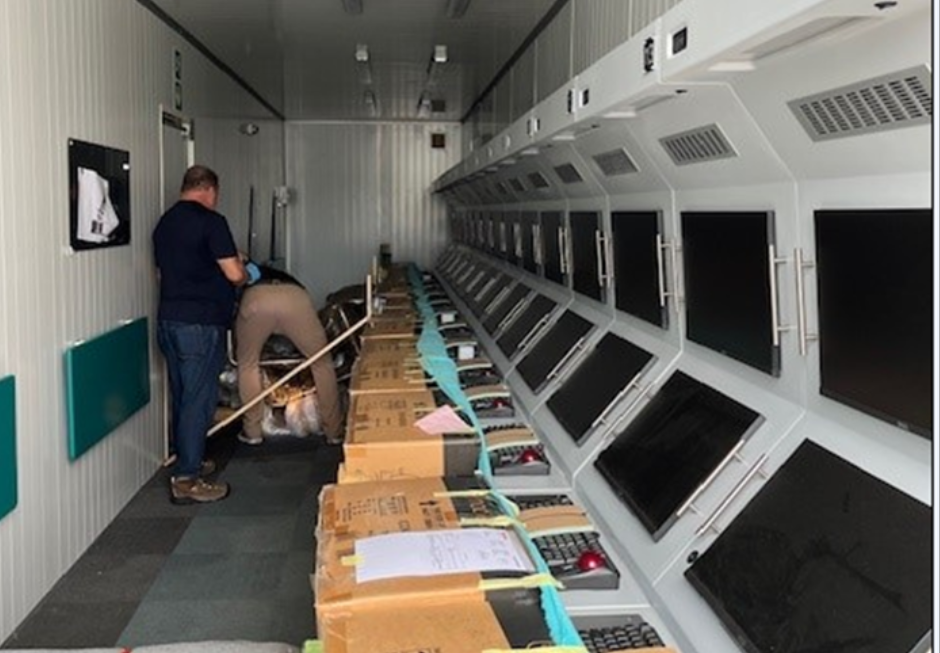
The U.S. Department of Justice (DOJ) has filed a civil forfeiture complaint to seize two mobile mission crew trainers (MCTs) that were intercepted en route from South Africa to China’s People’s Liberation Army (PLA), alleging the equipment was designed to enhance Beijing’s anti-submarine warfare capabilities using unauthorized U.S.-origin technology.
The trainers, housed in shipping containers, were produced by the Test Flying Academy of South Africa (TFASA) under an internal project codenamed “Project Elgar.” According to court documents, the MCTs were modeled after the layout of the U.S. Navy’s Boeing P-8 Poseidon, America’s primary maritime patrol aircraft used for detecting and tracking submarines.
U.S. officials claim the systems incorporated a basic flight simulator program from a U.S. company, which TFASA engineers allegedly enhanced with restricted defense technical data on Western anti-submarine warfare aircraft, including the P-8. Former NATO aviators with expertise in these techniques were reportedly part of the development team. No required export licenses were obtained under U.S. laws such as the Export Control Reform Act and Arms Export Control Act.
“The Test Flying Academy of South Africa illegally exported U.S. military flight simulator technology and recruited former NATO pilots for the purpose of training China’s military, jeopardizing U.S. national security and placing the lives of American service members at risk,” said Roman Rozhavsky, Assistant Director of the FBI’s Counterintelligence and Espionage Division.
Assistant Attorney General John A. Eisenberg described TFASA as masquerading as a civilian flight-training academy while acting as “a significant enabler of the Chinese air and naval forces and a pipeline for transferring NATO aviation expertise, operational knowledge, and restricted technology directly to the People’s Liberation Army.” The seizure, which occurred in Singapore in late 2024 while the containers were aboard a COSCO ship bound for China, is part of ongoing U.S. efforts to disrupt networks aiding China’s acquisition of sensitive military technology.
The action follows TFASA’s addition to the U.S. Department of Commerce’s Entity List in June 2023 for allegedly providing Western and NATO-sourced training to Chinese military pilots.
TFASA has strongly denied the allegations. In a statement on its website, the company asserted that the containers held only “basic mobile classroom units” for mission crew training focused on crew resource management (CRM) in maritime patrol aviation. It emphasised that the equipment used publicly available information and commercially licensed software, contained no tactical simulators, advanced systems, classified material, or mission-specific military capabilities, and had been vetted by relevant authorities prior to shipment.
“The Company rejects any suggestion that NATO expertise was transferred, or that any U.S. military technology, defence technical data, or other restricted information was exported in breach of applicable laws,” TFASA said, describing the claims as “factually incorrect or misleading.”
South Africa’s Department of International Relations and Cooperation has indicated it will engage constructively with the United States through diplomatic channels to clarify the facts.
The announcement coincides with joint naval exercises involving China, Russia, and Iran in South African waters, which began around January 10, 2026, though U.S. officials have framed the forfeiture as part of broader national security measures rather than a direct response to the drills.
The investigation remains active, led by the FBI, Homeland Security Investigations (HSI), and the Commerce Department’s Bureau of Industry and Security. In civil forfeiture proceedings, the U.S. government must prove the equipment is subject to seizure due to violations of export controls.