


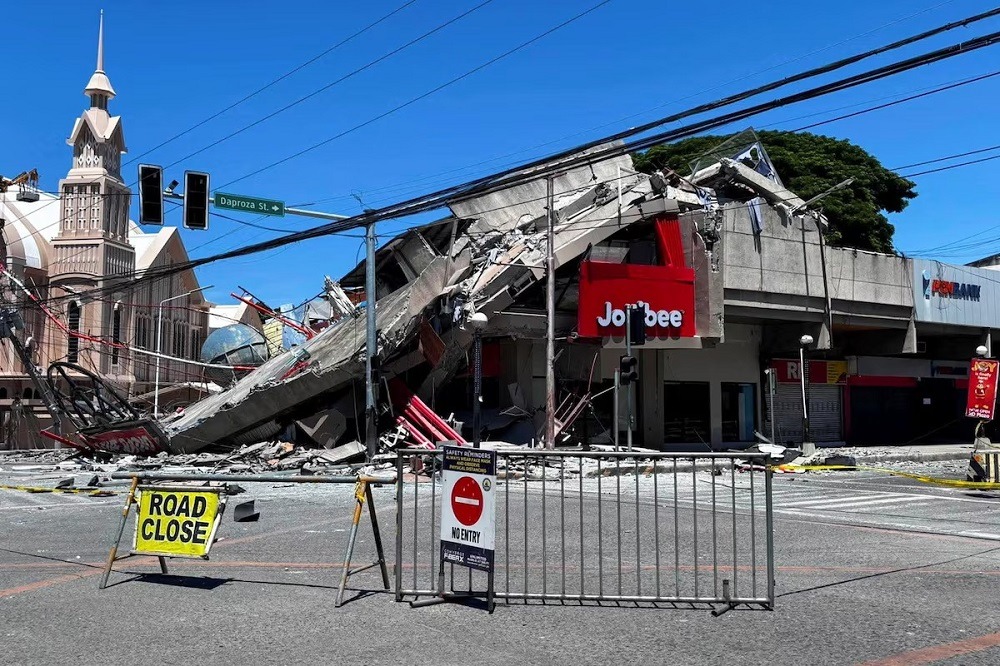
Emergency systems across Southeast Asia were rapidly activated after a powerful magnitude 7.8 earthquake struck off the southern Philippines island of Mindanao, prompting coordinated tsunami warnings and large-scale evacuations in multiple countries.
The quake, which hit early Monday morning near Sarangani province, caused strong tremors across the Philippines and was felt hundreds of kilometres away in Indonesia’s Sulawesi region. Its offshore epicentre placed coastal communities at immediate risk, triggering a swift chain reaction of regional alerts.
Authorities in the Philippines reported early indications that at least 15 people may have died, with more than 100 injured, though official verification is still ongoing. Many of the injuries were caused by collapsing structures, falling debris, and panic during evacuation.
The disaster response was quickly escalated by President Ferdinand Marcos Jr, who ordered national agencies to deploy emergency teams, open evacuation centres, and prioritise rescue operations in Mindanao.
Emergency coordination extended beyond the Philippines as tsunami warnings were issued across northern Indonesia and Malaysia’s Sabah region, while Pacific monitoring agencies tracked potential wave activity across the wider region.
The quake occurred within the highly active Pacific Ring of Fire, a region responsible for many of the world’s most powerful seismic events, making rapid multi-country response protocols critical.
Seismological agencies reported multiple aftershocks following the main quake, including one measuring magnitude 6.7, adding pressure on already strained emergency services and complicating damage assessments.
In affected Philippine cities such as General Santos, emergency crews responded to building collapses, hospital evacuations, and damaged infrastructure. Videos shared by local authorities showed rapid structural failures in commercial areas, forcing residents to flee into open streets as aftershocks continued.
Schools and public institutions were also impacted, with some buildings sustaining damage and being evacuated as a precaution. Despite the disruption, officials confirmed that several reported structural collapses occurred without casualties due to timing and early evacuation.
Regional tsunami monitoring centres, including the US Tsunami Warning System and Japan’s Japan Meteorological Agency, issued advisories shortly after the quake, warning that wave activity could affect multiple coastlines across the Pacific basin.
In Indonesia, coastal residents in North Sulawesi and nearby islands moved inland after alerts were issued, with some areas recording small tsunami waves and minor structural damage. Emergency officials described the evacuations as precautionary but necessary given the uncertainty of wave behaviour following large offshore quakes.
Indonesia’s disaster mitigation agency reported that while damage appeared limited in some areas, monitoring and evacuation efforts remained active as a safety measure.
International support messages followed quickly. Malaysian Prime Minister Anwar Ibrahim expressed readiness to assist the Philippines, highlighting regional solidarity in the face of natural disasters.
The Philippines, Indonesia, and surrounding nations lie along the volatile seismic belt known as the Pacific Ring of Fire, where tectonic movement regularly produces earthquakes and volcanic activity. This geological reality has made coordinated disaster preparedness and rapid warning systems essential across the region.
As search and rescue operations continue, authorities are still working to determine the full scale of the damage, while monitoring for further aftershocks and potential secondary impacts such as landslides or additional structural failures.