



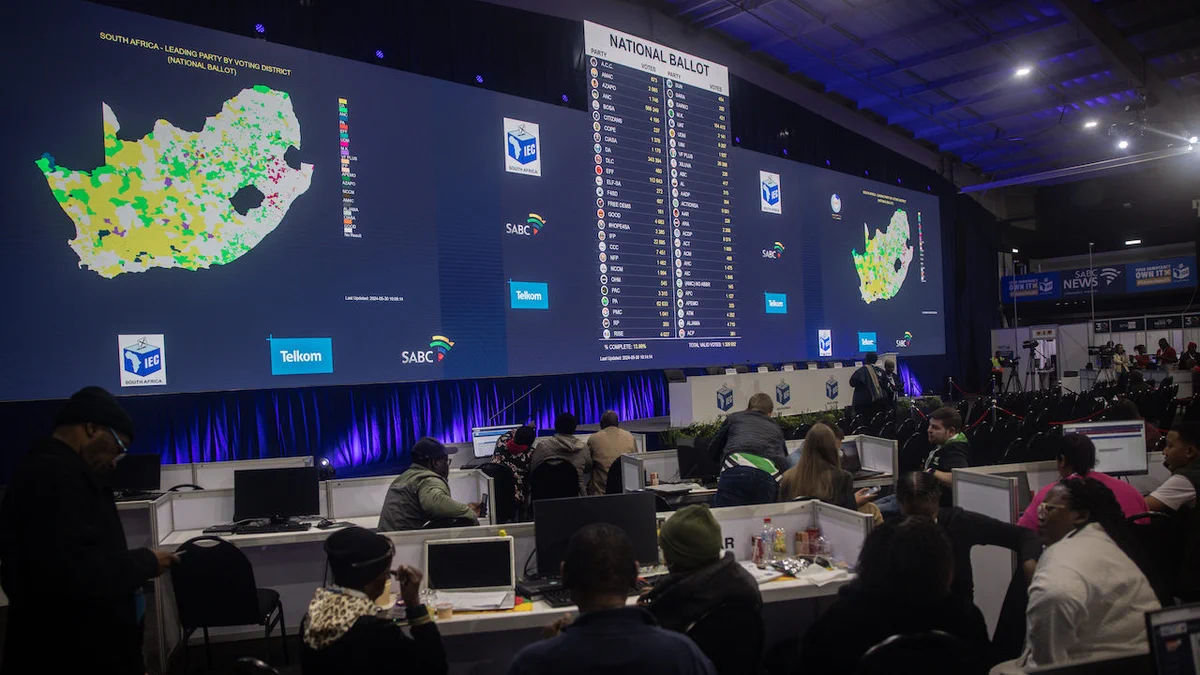
The clock is ticking for South Africa’s political parties as they face a 14-day deadline to form coalitions in 127 hung councils, while only 86 councils secured an outright majority following last week’s local government elections.
South Africa’s political landscape has been permanently altered. A country once dominated by a single liberation movement has officially transitioned into a highly fragmented and competitive multi-party system.
Coalition talks are officially under way following the formal declaration of the election results by the Independent Electoral Commission (IEC) on Sunday.
The commission declared the elections free and fair, revealing a highly fragmented political landscape in the country’s local government sector.
With a total voter turnout of 52%, up from the 45.9% recorded in 2021, 15 million citizens delivered a historic mandate, signalling that South Africa has officially become a “coalition country”.
Speaking on YOU FM Newshour, North-West University political analyst Dr Sysman Motloung said parties should avoid rushed and unstable ‘marriages of convenience’ simply to meet the deadline.
“A slight shift in dynamics may still emerge, but I believe these political parties have already anticipated this scenario.
“The advance polls were available, and the history of what occurred in 2021 provides valuable hindsight. By now, they should know exactly what pitfalls to avoid.
“Therefore, I do think that, to some extent, they fully anticipated this outcome,” said Motloung.
Motloung further argued that the possibility of coalition governments was entirely unavoidable.
“It was dishonest for some of them to claim they would secure an outright majority.
“Given the advance polls and the trajectory of what had already happened at national level, where no single party garnered a majority, this scenario was entirely predictable.
“With that recent historical background, those who still expected an outright majority were either unwise or dishonest.
“They should have anticipated this outcome and been prepared to state immediately who they were willing, or unwilling, to work with,” explained the political analyst.
Meanwhile, the African National Congress (ANC) faces a difficult balancing act after suffering significant losses in the elections.
Motloung, however, believes the party can still negotiate from a position of strength while determining which parties to partner with to retain its influence in local government.
“I do think they still have the upper hand.
“The ANC has garnered 30%, which is better than what any other party received in these polls.
“However, it depends on which party they are considering for a potential coalition and whether that party views an association with the ANC as ideal or positive.
“While the ANC is losing electoral support, this certainly does not mean they are out of the game,” cautioned Motloung.
The party’s performance has been poor in several key metropolitan councils, including Johannesburg, Tshwane and Ekurhuleni, where the Democratic Alliance (DA) has emerged as the leading party.

