


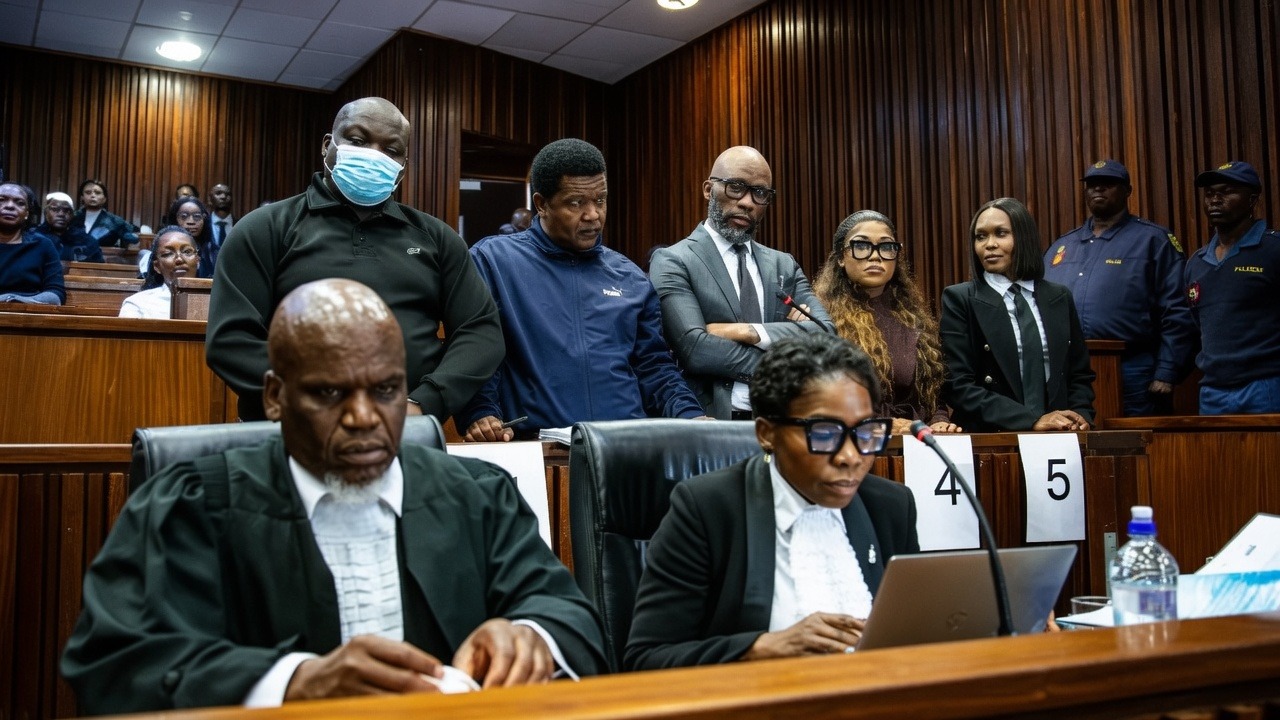
The defence in the trial-within-a-trial involving alleged crime kingpin Vusimuzi “Cat” Matlala and four co-accused has intensified its attack on the State’s identification evidence, arguing that the key witness’s version has shifted since the day of the arrest.
Private security officer Christiaan Shepherd was challenged in the Johannesburg High Court over discrepancies between his testimony and the statements he gave police after Musa Kekana’s arrest.
While Shepherd told the court he recognised Kekana by his distinctive mustard-coloured top, facial features and “bulky” build, defence counsel Advocate Rian Gissing pointed out that none of those additional identifying features appeared in the witness’s two police statements.
Instead, the statements referred only to the mustard-coloured top worn by the driver.
Gissing argued that the omission of any reference to the driver’s face or physique supported the defence’s contention that Shepherd never had a clear view of the driver and based his identification solely on the clothing.
Shepherd rejected the suggestion, insisting he had seen the driver’s face and describing the omission as an error.
“Just because I didn’t mention it, it doesn’t mean that is not the case,” he told the court.
Pressed further on why he failed to include a description of the driver’s facial features in his contemporaneous statement, Shepherd admitted it had been “a mistake on my behalf”.
The defence also questioned the witness over changing descriptions of the garment allegedly worn by the driver. During his evidence, Shepherd referred to it at different times as a shirt, a long-sleeved top and later what appeared to be a tracksuit top, prompting the defence to argue that his recollection had become unreliable.
The cross-examination forms part of an interlocutory application to determine whether evidence obtained following Kekana’s arrest should be admitted in the main trial.
Kekana denies he was driving the Hyundai i20 on the day in question and maintains he was at his home when the alleged offences were committed.
The court is expected to decide whether the disputed evidence meets the threshold for admission before the main trial proceeds.