



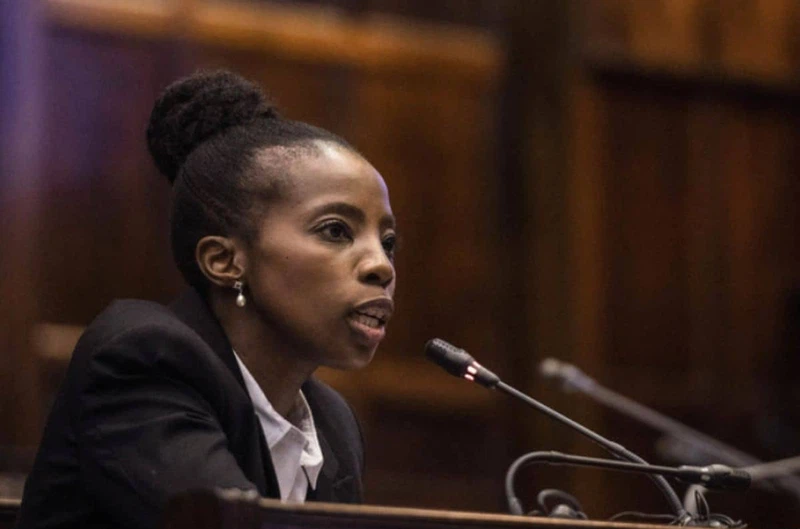
Public Protector Advocate Kholeka Gcaleka has called for legislative amendments to make the deliberate failure to implement her office’s remedial actions a criminal offence, stressing that compliance is essential to ensuring accountability, access to justice and meaningful redress for ordinary South Africans.
Speaking at the three-day International Conference on Access to Justice for All, held at Sun City near Rustenburg, Gcaleka highlighted the critical role of ombudsman institutions in bridging the gap between the country’s constitutional promises and the everyday experiences of its citizens.
She reiterated this commitment during an interview on YOU FM Newshour, where she pledged to continue advocating for amendments to the Public Protector Act to strengthen and accelerate the enforcement of her office’s remedial actions.
Gcaleka acknowledged that implementation of the Public Protector’s recommendations had improved significantly. However, she emphasised that the ultimate objective remained achieving full compliance to ensure that affected individuals experienced tangible results.
“The biggest hurdle that persists in the 30 years of the Public Protector’s existence is the efficient implementation of our remedial action.
“Yes, we have increased (implementation) drastically from about 2% over four years ago to 67% currently, but we want it to be at 100% so that ordinary people can feel the redress and experience the difference.
“In that regard, we are proposing an amendment to our Act so that the non-implementation of the Public Protector’s remedial action is regarded as contempt of the Public Protector, and thus a criminal offence,” said Gcaleka.
Public Protector Expands Access to Justice in Rural Communities
Gcaleka also outlined measures being introduced to make the Public Protector’s services more accessible to South Africans, particularly those living in remote and underserved rural communities.
She explained that, although the office maintains physical offices in Mahikeng and Rustenburg, it is strengthening its outreach initiatives to ensure that geographical barriers do not prevent people from seeking assistance.
Through community outreach clinics and its ‘Please Call Me’ system, which enables call centre agents to return calls to complainants, members of the public can access assistance without necessarily having to travel to an office.
The office is also preparing to establish satellite offices in deep rural areas, aligned with local magistrates’ court and municipal districts.
The initiative aims to reduce the financial and logistical difficulties faced by people who would otherwise have to walk long distances or pay for long-distance taxi journeys to access the Public Protector’s services.
“To make our office even more inclusive, we are also preparing to open satellite offices in deep rural areas, aligned with local magistrates’ court and municipal districts, so people don’t have to walk long distances or take long-distance taxis to reach us,” explained Gcaleka.
Public Protector’s Constitutional Mandate
Gcaleka highlighted that, in terms of Section 181 of the Constitution, the Public Protector is among the independent institutions established to strengthen constitutional democracy.
Her office provides a free and accessible mechanism through which members of the public can lodge complaints and seek investigations into alleged improper conduct in state affairs and public administration.
These matters include undue delays in basic service delivery, maladministration and the misuse of state resources.
Meanwhile, President Cyril Ramaphosa, who delivered the keynote address at the conference, emphasised the importance of justice systems that are accessible, responsive and centred on the needs of ordinary people.
He cautioned that a justice system that is inaccessible, delayed or reserved for the privileged undermines democracy.
The discussions at the conference highlighted the importance of strengthening accountability mechanisms and ensuring that constitutional rights translate into meaningful improvements in people’s lives.

