



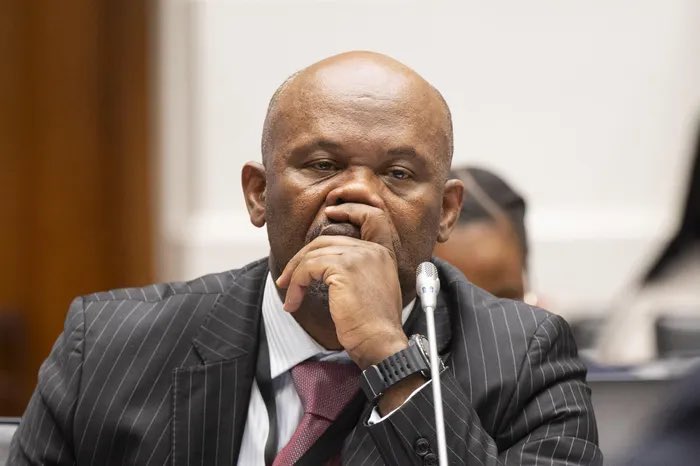
Suspended Deputy National Police Commissioner Shadrack Sibiya has attributed his current legal troubles to what he describes as political interference and populist tactics by KwaZulu-Natal Police Commissioner Nhlanhla Mkhwanazi.
Sibiya claims the controversy began on 6 July 2025, when Mkhwanazi held a widely publicised media briefing alleging that drug cartels had infiltrated South Africa’s criminal justice system. Those claims triggered a series of investigations, including the establishment of the Madlanga Commission.
He further referenced his appearance before Parliament’s ad hoc committee established to probe the allegations, singling out the uMkhonto weSizwe Party (MKP) as having used the platform to target him.
“Throughout this process, I was subjected to what I consider humiliating questions,” Sibiya said. “I was publicly undermined, even after my testimony. With every witness who appeared, there were remarks from the MK Party that belittled and discredited me. I appeared to be the primary target of these attacks.”
Sibiya also alleged that a criminal case opened against him by the MKP formed part of a coordinated effort with rivals within the South African Police Service (SAPS) to force him out of office.
“The MK Party opened a case against me. Their statement was later used by a brigadier to apply for a search warrant when my home was raided. The same party marched against me at head office. While I was sitting in my office, I could hear the protests outside,” he said.
“All of this created a situation where I felt politically targeted. Beyond the allegations relating to the so-called ‘121 dockets,’ there was mounting pressure to push me out of office, despite my belief that I had done nothing wrong.”
Sibiya, who was previously dismissed from the police service, argued that his earlier removal by then police minister Nkosinathi Nhleko, as well as a Public Protector South Africa investigation into alleged unlawful covert activities during his time with the City of Johannesburg, formed part of a long-running campaign against him.
He noted that Nhleko — now national chairperson of the MKP — was serving in the Cabinet of former president Jacob Zuma at the time of his dismissal. Zuma later founded the MKP. Sibiya also pointed out that former Johannesburg council speaker Colleen Makhubele now serves as a senior MP within the party.
“When we were removed from office, it was Minister Nhleko who dismissed us. He is now associated with the MK Party. At the time, President Zuma was in office,” Sibiya said.
He further alleged that Mkhwanazi had been advised to approach the City of Johannesburg to obtain information about him and had sought a statement from an individual previously investigated by Sibiya. According to Sibiya, that individual acknowledged having a personal relationship with Makhubele and expressed support for Mkhwanazi.
“To me, this indicates that the matter remains political,” he said.
Turning to Mkhwanazi’s public profile, Sibiya described the provincial commissioner as a populist figure whose strong social media following made it difficult for him to perform his duties effectively.
“There is one provincial commissioner whose name, photographs and daily activities are widely circulated on social media. I am informed that there are thousands of accounts posting content in support of him,” Sibiya said.