


France has suspended the use of stun grenades during high school protests after a teenager lost a hand, as growing concerns over police tactics add to pressure on President Emmanuel Macron’s government.
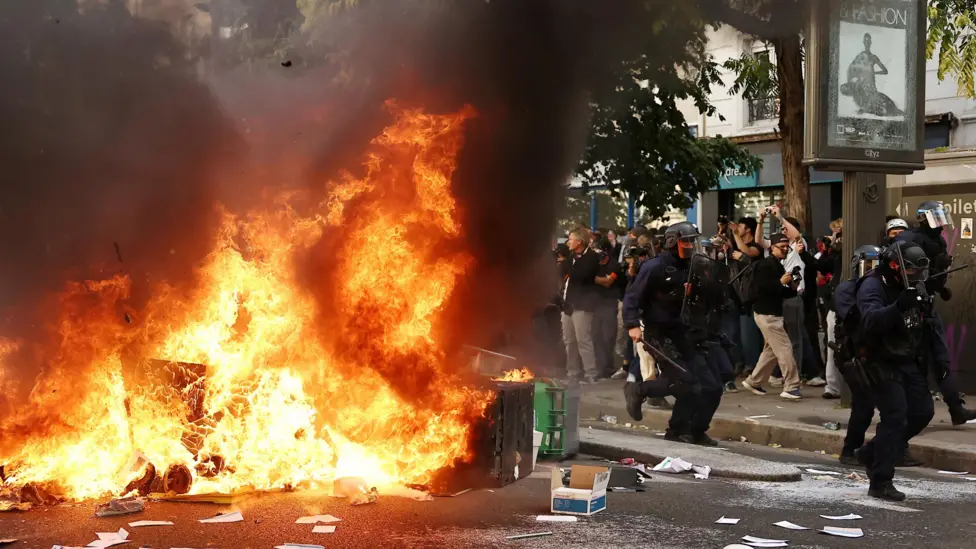
Mass demonstrations over deteriorating conditions at French high schools descended into sporadic violence on Tuesday, with nearly 500 arrests and dozens of security officers injured.
The protests began in late September, when students started blocking entrances to hundreds of schools in a campaign over teacher shortages, overcrowded classrooms and deteriorating facilities.
More than 6,500 people, mostly minors, have been arrested since the movement began, according to authorities.
Teenagers injured during protests
The controversy over the police response intensified after a teenager lost a hand on Monday after a stun grenade was fired by police.
A 14-year-old student in north-west Paris was also struck in the face by a tear gas grenade at close range, losing several teeth. A police officer was charged on Tuesday in connection with the incident.
Rights groups, unions and student representatives have accused authorities of using disproportionate force.
Amnesty International called on French authorities to end what it described as disproportionate police repression during the protests.
Interior Minister Laurent Nunez said police had opened 10 internal investigations into allegations of misconduct.
The government said 215 students and 715 police officers had been injured since the start of the movement, while 85 teaching staff had also been hurt.
Nearly 500 arrests in one day
The Interior Ministry said 256,000 people demonstrated nationwide on Tuesday, while union organisers estimated the turnout at 450,000.
At least 488 people were arrested and 43 members of the security forces were wounded during Tuesday’s protests, according to the ministry.
In Paris, parents, teachers and union workers joined students in a large demonstration through the capital.
The march was largely peaceful before tensions escalated near its endpoint at Place de la République, where police fired tear gas and some protesters threw rocks at officers carrying riot shields.
Police said about 300 “hostile individuals” attempted to confront officers.
Some demonstrations elsewhere in France have also involved fires, damage to bus shelters and clashes with riot police.
Prime Minister Sébastien Lecornu condemned the violence, telling lawmakers that attacks and destruction would not be tolerated.
“Burning down a high school does not improve the state of high school buildings,” Lecornu said, rejecting accusations that the government had ordered police repression against protesters.
He also announced that high schools across France would close for half a day between Wednesday and Friday to allow what he called “internal democracy” within schools.
Students demand better conditions
Despite the violence, students say the demonstrations are rooted in long-standing problems inside French schools.
Thomas, a 17-year-old student from Val-de-Marne, said some classrooms at his school lacked enough desks and chairs, while bathrooms had no doors, toilet paper or soap.
“We just want better conditions for studying,” he told AFP.
Nineteen-year-old Lilia, speaking at the Paris march, said young people wanted their concerns to be taken seriously.
“Gen Z has risen up and wants to be heard,” she said.
Protesters carried banners calling for greater investment in education, including one reading: “Neglected schools, sacrificed youth.”
The Education Ministry said 24 schools had been burned or ransacked since the start of the movement.
Teachers and parents have also joined demonstrations, with teacher Rindala Younes in Lyon saying students’ demands were legitimate and should be conveyed peacefully.
Macron calls emergency meeting
Macron was expected to meet senior officials, including Nunez and Education Minister Édouard Geffray, in response to the unrest.
The protests come ahead of France’s 2027 presidential election, adding a political dimension to the growing pressure on the government.
The hard-left France Unbowed (LFI) party has backed the students’ demands, although its veteran presidential candidate Jean-Luc Mélenchon has called for protests to remain peaceful.
US President Donald Trump also weighed in on Tuesday, attributing the unrest to “mass migration” and Islam. French protesters and officials, however, have centred their complaints on education funding, school conditions and staffing shortages.
The unrest has also spread beyond France. In neighbouring Belgium, students in Liège launched a similar protest movement, with several arrested after police reported clashes and vandalism during a demonstration.
Additional reporting AFP