



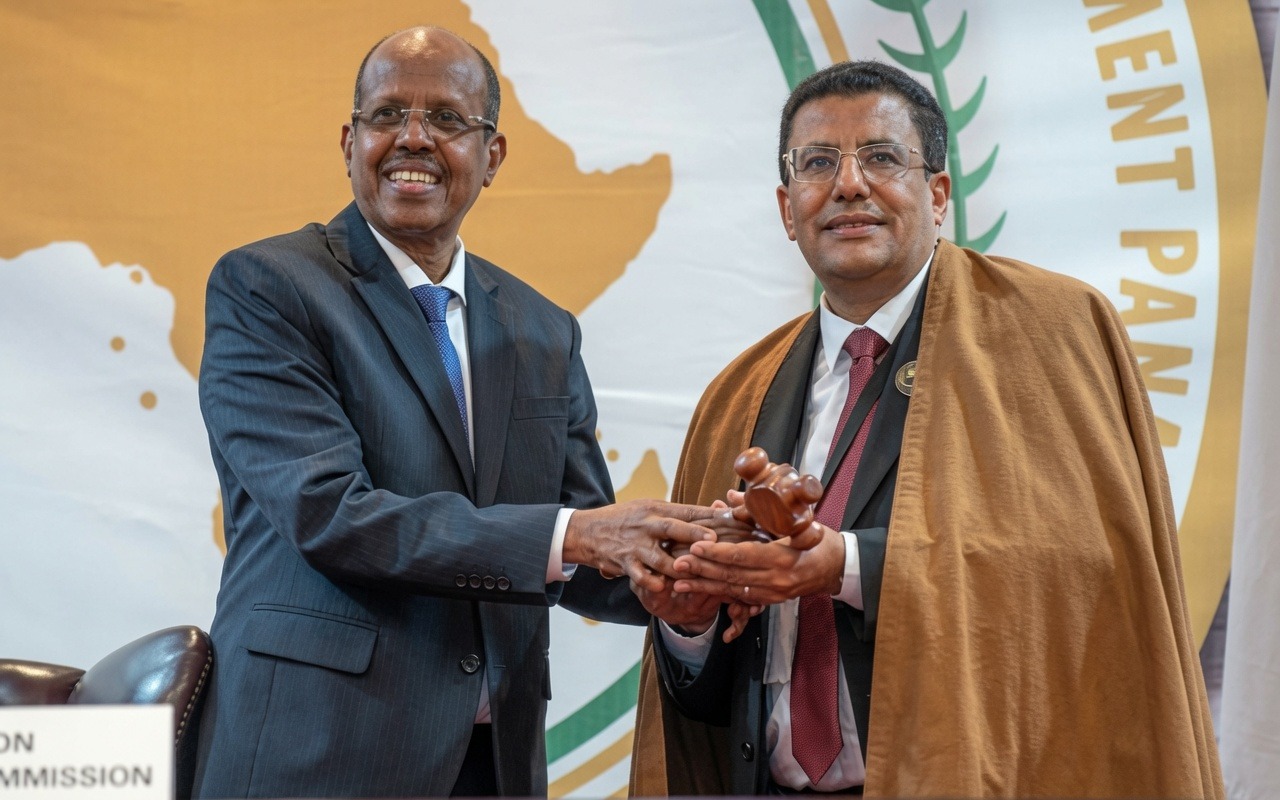
The agenda for reparations linked to colonialism and the transatlantic slave trade is expected to gain momentum as the new leadership of the Pan-African Parliament (PAP) settles into office, with a clear objective of strengthening the institution through reforms and promoting initiatives such as the African Continental Free Trade Area (AfCFTA).
A key priority for the new leadership is the ratification of the Malabo Protocol (2014). Its adoption would transform the PAP from a consultative body into a legislative institution with meaningful powers.
Although reparations were not discussed during the PAP’s recent sitting in Midrand, South Africa, the new leadership elected in April, headed by President Fateh Boutbig of Algeria, is expected to receive submissions from member states seeking clear resolutions on the issue, which has already been identified as a priority by the African Union (AU).
The PAP’s decision not to discuss reparations at the recent sitting is not viewed as reluctance, but rather as a matter of timing, as the continental legislative body was focused on addressing internal operational matters, including improving its electoral processes.
The Pan-African Parliament has placed the African Union’s theme of “Justice for Africans and People of African Descent through Reparations” at the centre of its broader legislative agenda. The focus includes economic compensation, institutional reforms and the return of cultural artefacts removed during slavery and colonialism.
Key areas of reparatory justice include:
Economic redress:
Advocating for financial compensation and development assistance to address the impact of decades of colonial exploitation.
Cultural restitution:
Supporting the recovery and return of African cultural artefacts and heritage items taken during slavery and colonisation.
Systemic reforms:
Promoting structural changes within global governance, education systems and international legal frameworks.
Strategic actions and institutional development
The PAP is working towards integrating reparatory justice principles into African Union frameworks and international law.
It is also strengthening cooperation with civil society organisations through platforms such as the PAP–Civil Society Desk, following specialised dialogues held in Midrand, South Africa.
The Parliament has further called on AU member states to properly fund continental institutions to ensure greater independence from external donor financing.
The reparations agenda, which includes participation from Caribbean nations, has received additional support from South Africa, which has experience with restorative justice.
Last week, South Africa’s Minister in the Presidency, Khumbudzo Ntshavheni, stated that reparations were not negotiable, citing the compensation provided to Jewish communities after the Holocaust. She argued that Africans should not be treated as less deserving of recognition or justice.
“The Jews were compensated for the Holocaust, but Africans were not compensated for the slave trade and the after-effects of colonialism,” said Ntshavheni.
“Africans deserve not only an acknowledgement of the wrongs that were committed against them, but Africans deserve to be compensated. It is for that reason that in our own country, we are addressing the injustices of the past, the injustices of apartheid rule and colonialism,” she added.
Turning point
The year 2026 marked a significant turning point for the reparations movement, with the focus shifting from years of debate towards the development of international mechanisms and legal frameworks.
At the 39th Ordinary Session of the Assembly of Heads of State and Government of the African Union, the AU officially recognised the reparations agenda as a flagship project in February 2026. The initiative was incorporated into the priorities of Agenda 2063 and expanded into the Decade of Justice and Reparations (2026–2035).
Global recognition of historical injustices
On 25 March 2026, the United Nations General Assembly adopted Resolution A/RES/80/250, recognising the transatlantic slave trade as a crime against humanity of the utmost gravity.
The resolution linked the historical impact of slavery with present-day inequality, racism and discrimination, while endorsing reparations as a measure to address historical injustices.
United front between Africa and the Caribbean
The Accra Summit held in June 2026 saw African and Caribbean nations present a united position on reparations. The meeting resulted in the adoption of a joint Plan of Action aimed at advancing justice and compensation efforts.
However, concerns remain over the limited involvement of the Pan-African Parliament in driving the agenda forward.
The new PAP leadership has acknowledged that Africa is closely watching the institution’s work, with calls growing for the development of a model law on reparations.
Supporters argue that momentum must not be lost, particularly as some European countries have begun returning cultural artefacts, including commitments by the Netherlands and Germany to return around 2,000 artefacts to Ghana, while France has agreed to return 26 royal statues to Benin.
In December 2024, in Dakar, Senegal, PAP Third Vice-President Hon. Lucia Dos Passos announced plans to develop model legislation that would enable African countries to pursue justice and compensation from former colonial powers through a unified legal framework.
The announcement was included in the Gorée Declaration, where participants called on the PAP to develop and adopt such legislation.
During the PAP’s 5th Ordinary Session in Midrand, the Committee on Justice and Human Rights presented a comprehensive report on reparatory justice, which was unanimously adopted.
The report included recommendations to advance model legislation, incorporate reparations into national budgets and strengthen parliamentary diplomacy.